







Divorce and family disputes,
resolved with an attorney who knows them
Property division, custody, consolation money. The divorce team at Daehanjoongang Law Firm works to protect what you are entitled to.


Divorce and family insights
Current issues and legal developments, set out by our attorneys
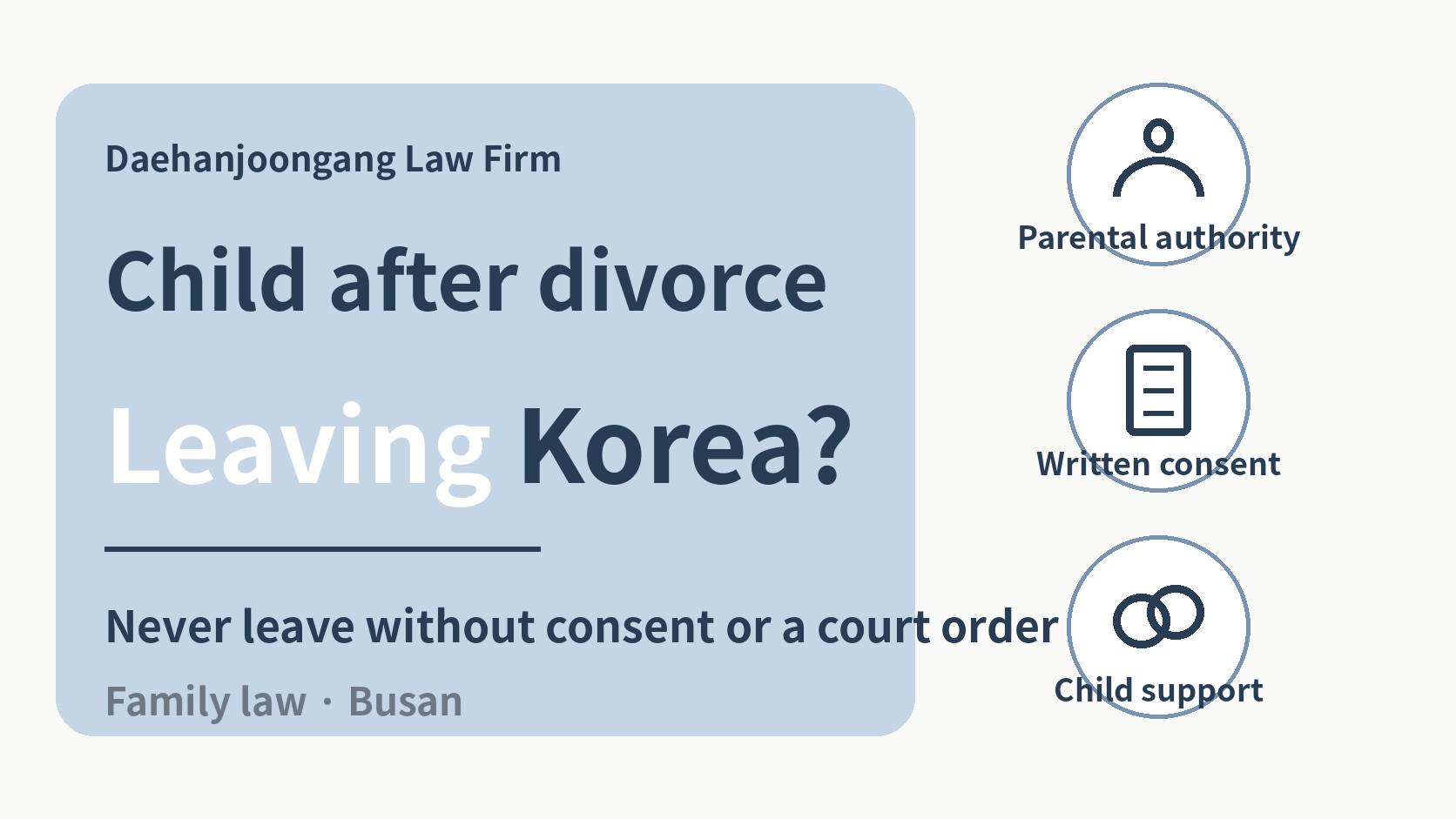
Can I take my child to my home country after a divorce in Korea?
Only once the custody question is settled, and even then it depends on what the decision gives you. Until the divorce is final, both parents hold parental authority (친권) together, …
Which country's court and law decide my international divorce?
If you live in Korea and the two of you last lived together here, a Korean family court can usually hear your divorce, e…
Can I stay in Korea on an F-6 visa after a divorce?
Often you can, but not automatically. The marriage migrant visa (결혼이민, F-6) exists because you are married to a Korean n…
Divorce and family matters:
you do not have to work them out alone
From property division through custody and consolation money, protecting what is yours,
the Daehanjoongang Divorce Center stays with you, calmly, to the end.
The firm’s work, in numbers

Han Byung-chul, answering the public
A record of the legal questions our managing attorney has answered on the largest public Q and A service in Korea.
Updated automatically from public activity records
Our attorneys
Attorneys who have won a great many divorce and family cases

LAWYER
Lee Un-yeong

LAWYER
Lee Dong-gyu

LAWYER
Lee Gyu-hui

LAWYER
Yu Ji-hyeon

LAWYER
Oh Dong-jun

LAWYER
Shin Hye-rim

LAWYER
Shin Ye-won

LAWYER
Park Eun-jin

LAWYER
Park Su-gyeong

LAWYER
Park Min-jeong

LAWYER
Noh Hwan-ju

LAWYER
Kim Hyeon-do
LAWYER
Lee Un-yeong
LAWYER
Lee Dong-gyu
LAWYER
Lee Gyu-hui
LAWYER
Yu Ji-hyeon
LAWYER
Oh Dong-jun
LAWYER
Shin Hye-rim
LAWYER
Shin Ye-won
LAWYER
Park Eun-jin
LAWYER
Park Su-gyeong
LAWYER
Park Min-jeong
LAWYER
Noh Hwan-ju
LAWYER
Kim Hyeon-do
FAQ
Divorce and family law: common questions
The questions our divorce attorneys in Haeundae, Busan are asked most often at a consultation.
In a divorce by agreement the spouses agree on the divorce and on arrangements for any children and have that confirmed by the family court, after a reflection period of three months where there are children and one month where there are not. A divorce by court action is brought when there is no agreement, relying on one of the grounds in Article 840 of the Civil Act. Which route fits depends on how likely agreement is on property, children and compensation, so it is worth deciding at the first consultation.
The division covers property built up through the spouses’ joint effort during the marriage, and the share is set by weighing each spouse’s contribution, including income and work in the home. Property registered in one spouse’s name alone can still fall within the division, while property held before the marriage is in principle excluded. The actual proportion varies case by case, so it helps to have the full list of assets organised and reviewed in advance.
Custody is decided with the welfare of the child as the first consideration, taking into account the living arrangements, who has been the primary carer and, depending on age, the child’s own wishes. Child support is calculated from the parents’ incomes and the child’s age, with the court’s child support guidelines as the reference. If circumstances change later, either arrangement can be applied to be varied.
Consolation money is a claim for the mental suffering caused by the breakdown of the marriage, brought against the spouse responsible for it, or against a third party involved, in cases such as adultery, violence or malicious desertion. The amount is set by weighing the length of the marriage, how the breakdown came about and the degree of responsibility, and it is a separate claim from the division of property. Securing objective evidence in advance helps to establish it.
If there are issues about property, children or compensation, or if there are signs that the other spouse is already preparing to file, it is better to take advice early. Organising the list of assets and the evidence at the outset widens what can be done, whichever way the matter goes, by agreement or through the court.
Speak to a divorce attorney now
Reach us by phone or online, whichever suits you.